Aug 31, 2026
How to Choose LED Light Sources for Advertising Light Boxes
Compare LED lens bars, block lights, and flexible strips for advertising light boxes, with practical guidance on depth, spacing, brightness, CRI, efficiency, IP rating, and maintenance.
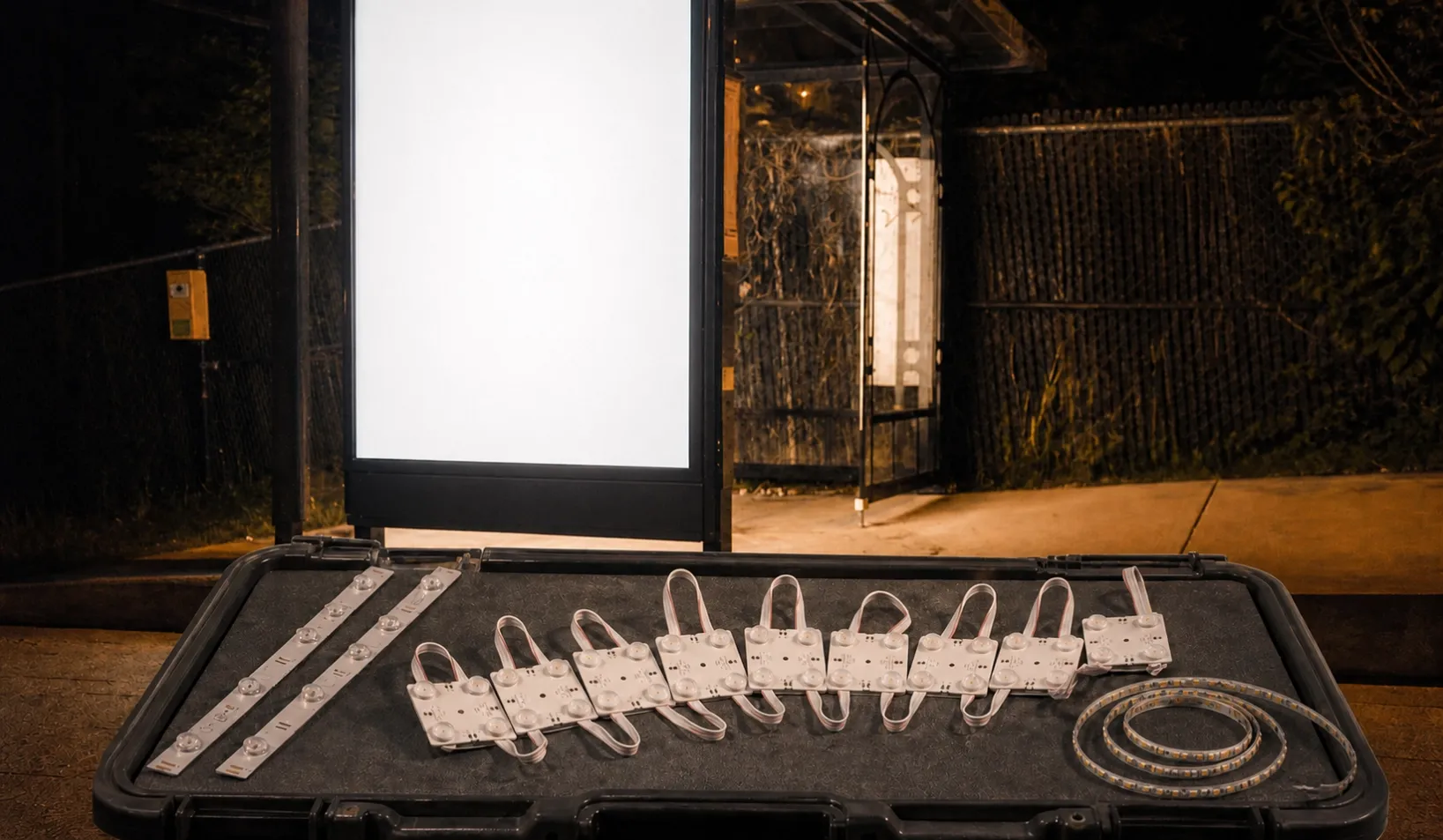
Flexible-face advertising light boxes are widely used in shopping malls, exhibition halls, hotels, and branded retail stores because they offer strong light transmission, flexible shapes, vivid color reproduction, and convenient installation. However, the real value of a light box is not simply that it lights up. It must make the graphic more visible, help the message stand out, and leave a strong brand impression.
If the light source is poorly selected or arranged, uneven brightness, dark areas, or visible hot spots can weaken even the best graphic design. The light source also affects energy consumption, service life, maintenance cost, and customer satisfaction. This guide compares the most common LED options and explains how to choose a practical solution based on light box depth, uniformity, brightness, color quality, efficiency, protection, and maintenance.
Common LED Light Sources for Advertising Light Boxes
1. LED Lens Rigid Bars
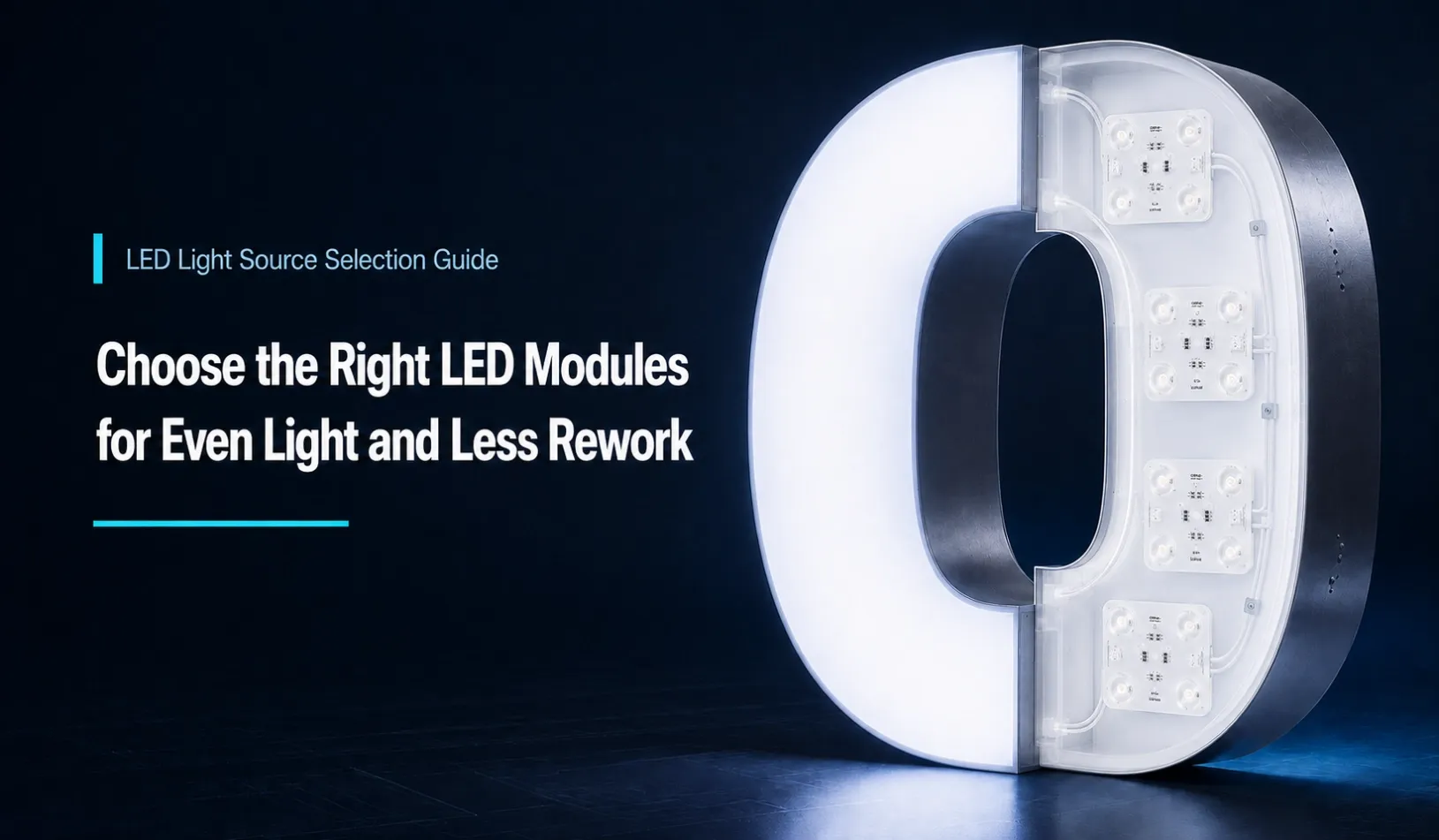
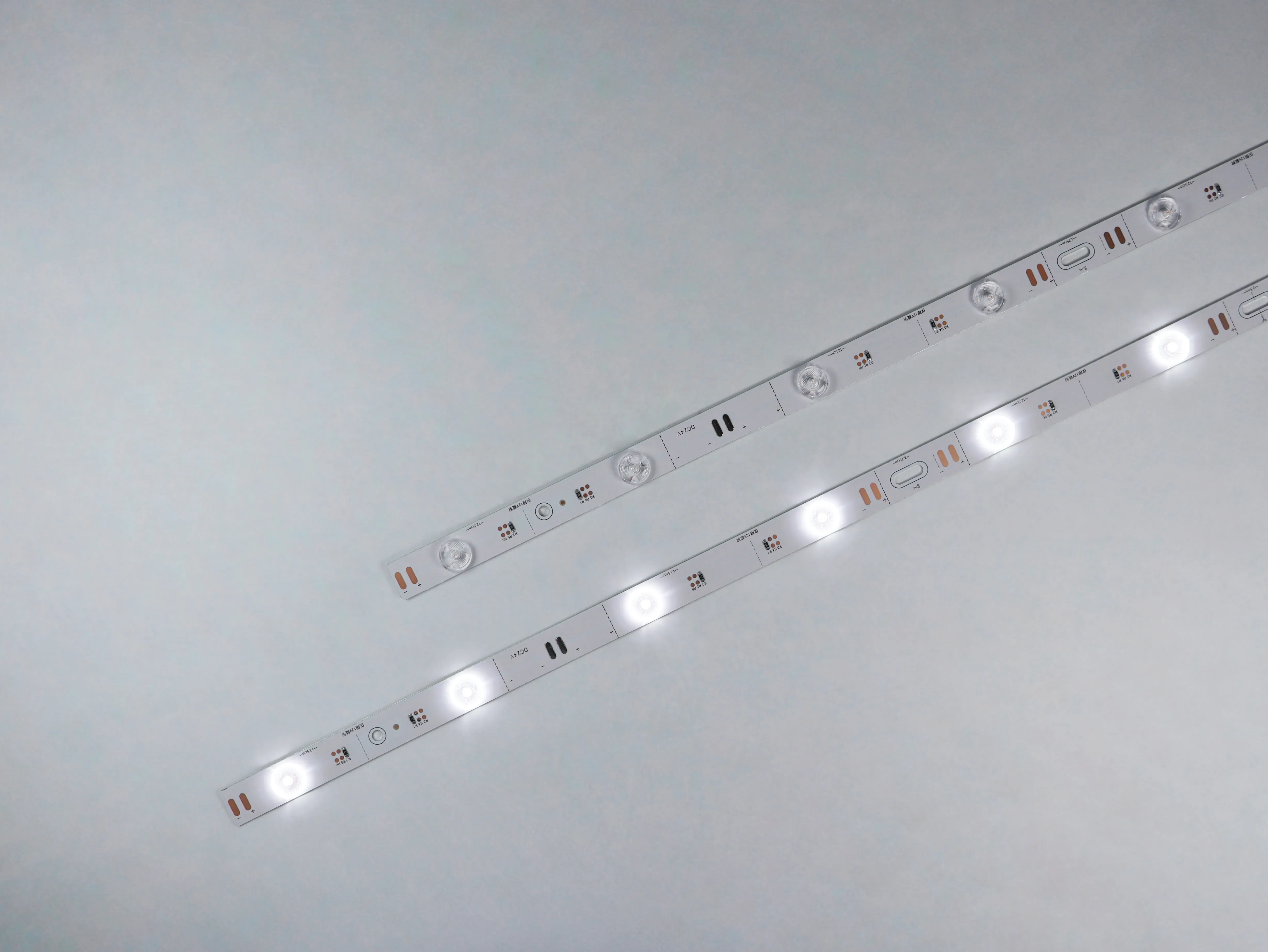
LED lens rigid bars are a common backlighting solution for regular light boxes. Each bar combines LEDs, optical lenses, and a rigid PCB. The bars are installed across the back or sides of the light box so that their beams overlap and create an even illuminated surface.
They are generally suitable for regular light boxes with a depth of about 8-25 cm. Their main advantages are high output, good luminous efficacy, long service life, and fast installation. However, the spacing must match the box depth and lens angle. Poor spacing can create visible bright lines or dark bands.
2. Wide-Angle LED Block Lights
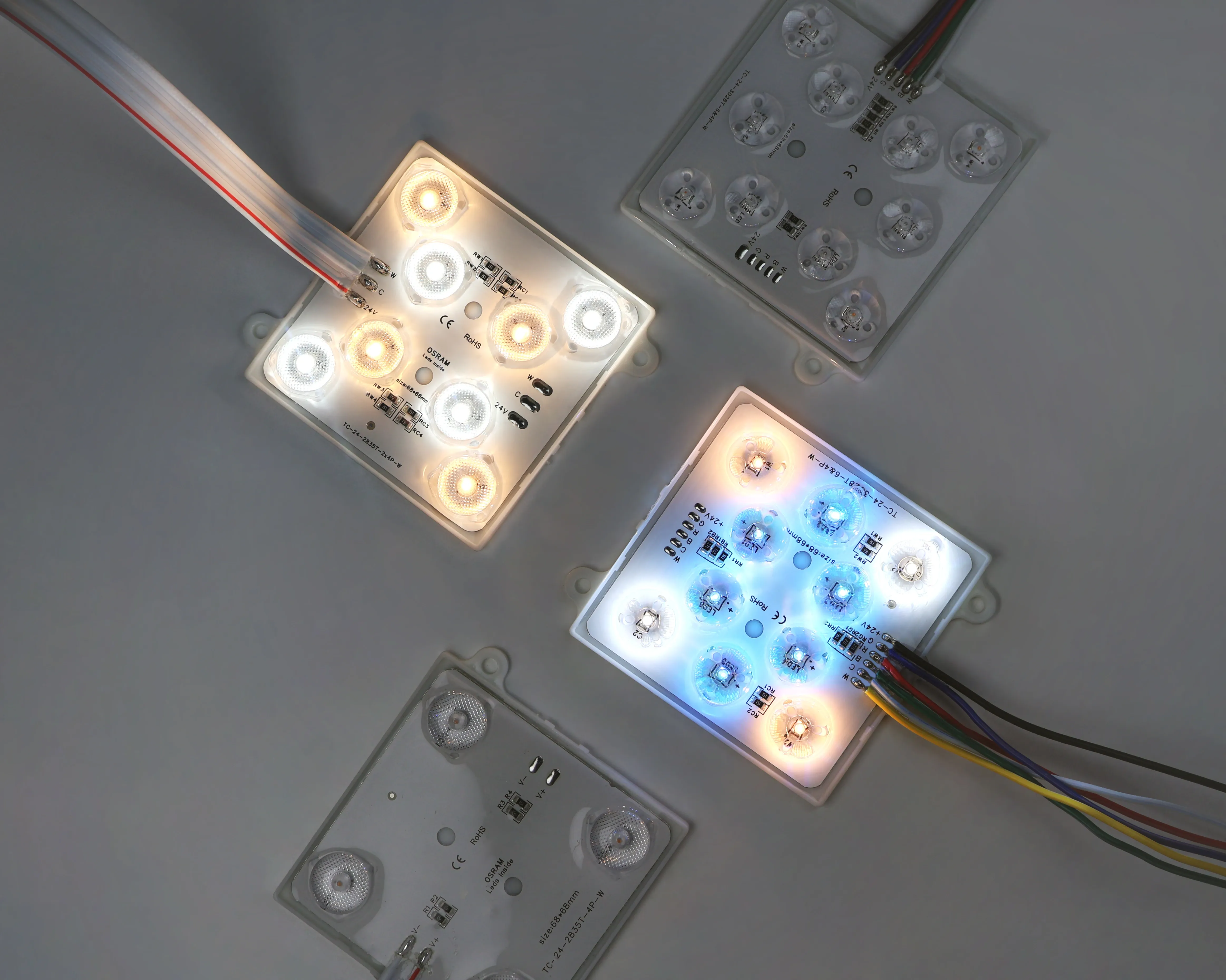
An LED block light combines a PCB, several LEDs, and optical lenses in a compact module. Multiple blocks are connected by wires to form a flexible lighting system. Wide-angle lenses spread light over a larger area, while the wired modules can be positioned around structural supports, lettering outlines, curves, and irregular shapes.
Block lights are often a strong choice for irregular light boxes, dimensional letters, flexible-face light boxes, and deeper enclosures. They are easy to position, convenient to replace locally, and may reduce the total module count when a wide beam angle is used correctly.
For a closer comparison of these two source types, see LED Strips vs. Block Lights: One Project, a 30% Cost Difference.
3. Flexible LED Strips
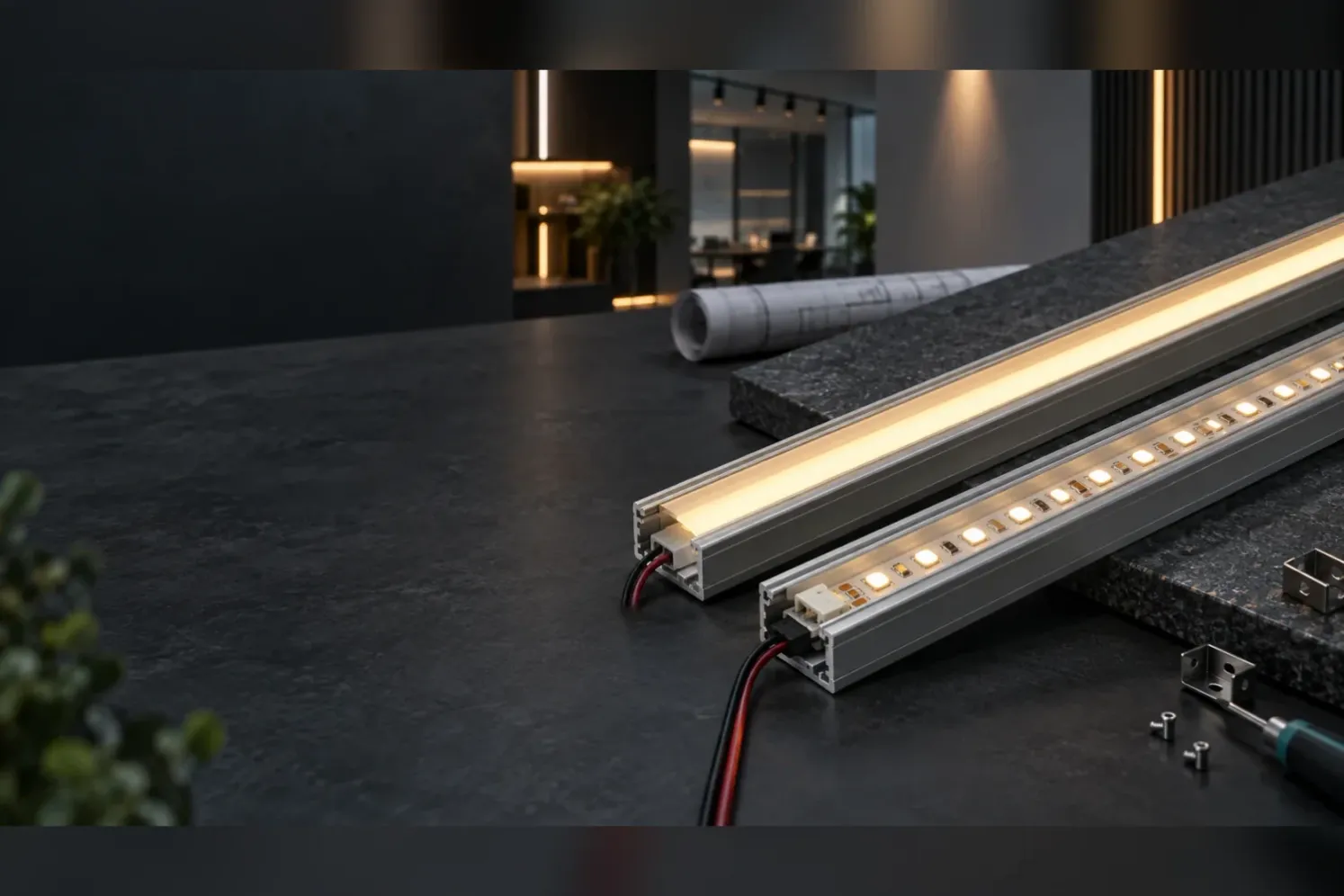
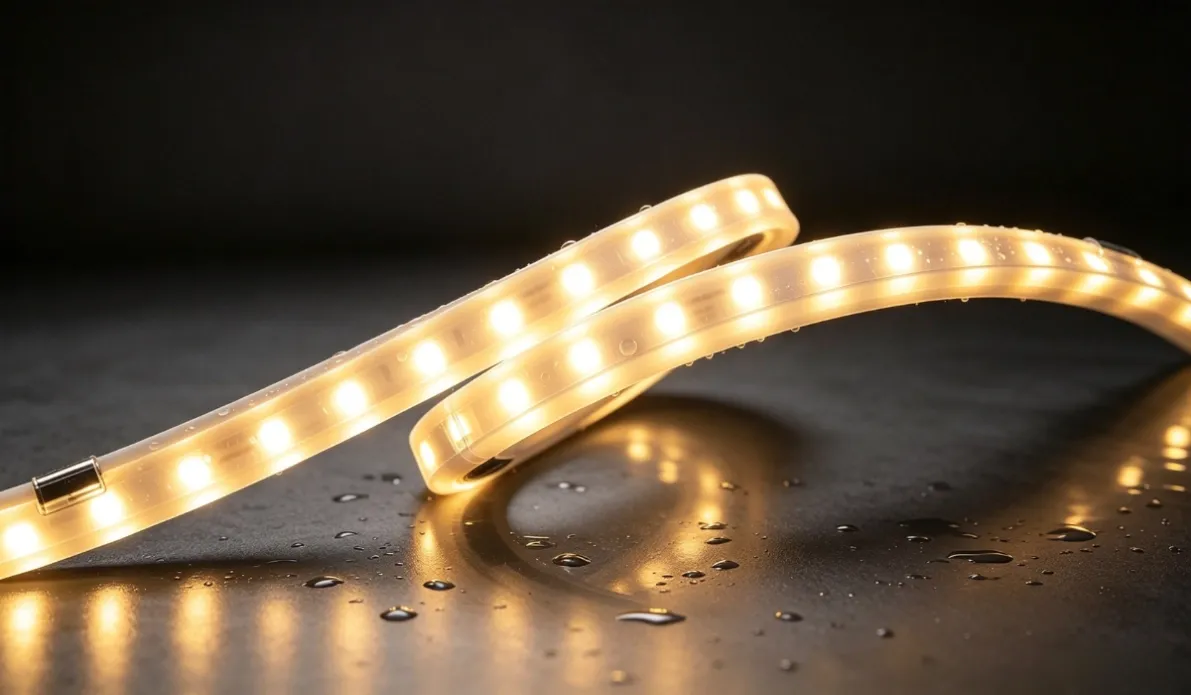
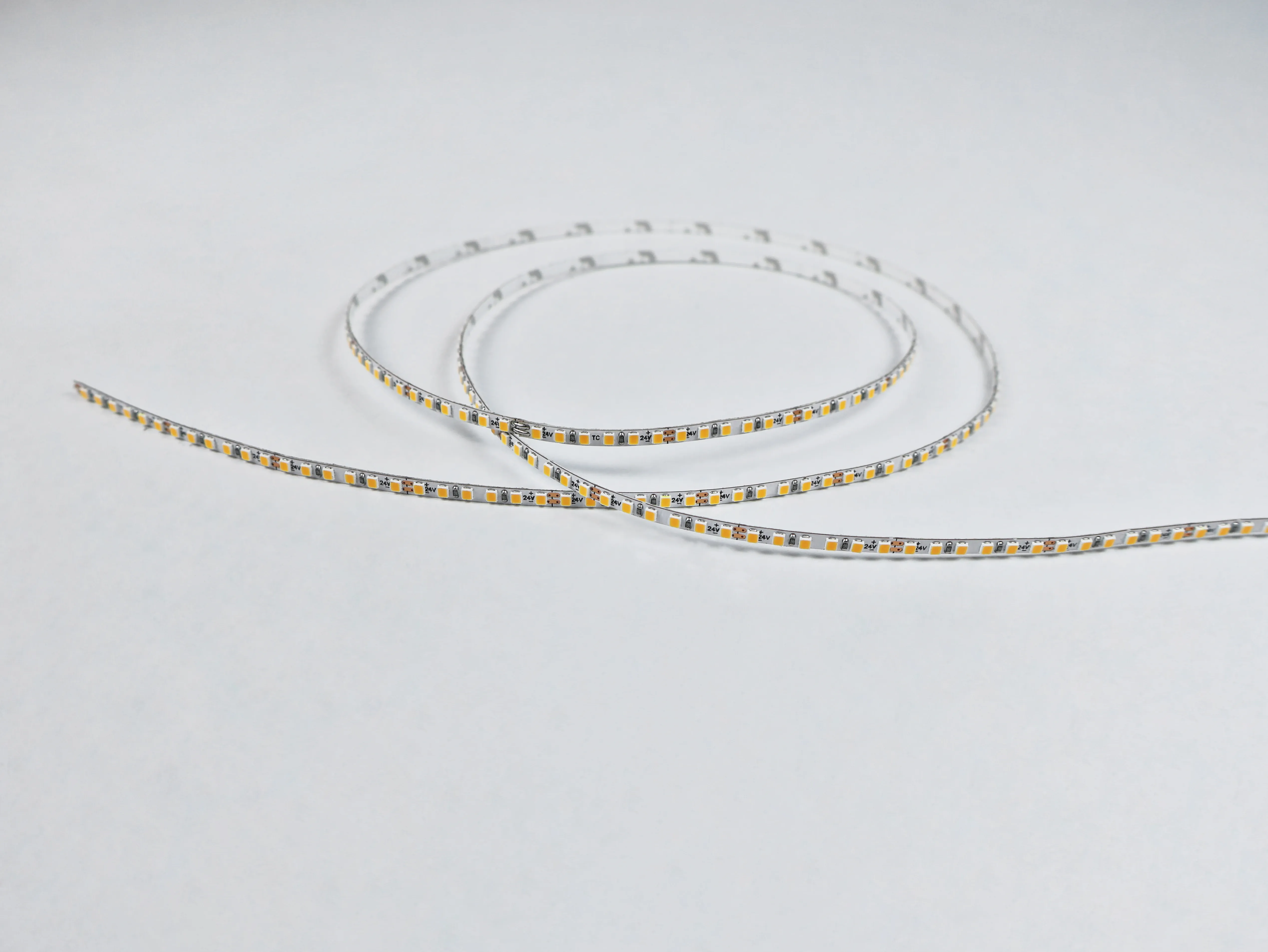
Flexible LED strips are easy to route and adapt to compact structures. They work well in small light boxes, regular shallow boxes, perimeter lighting, and designs with limited mounting space. High-density strips can improve light mixing, while ultra-narrow strips are useful in very slim assemblies.
Six Factors That Determine the Right Light Source
1. Face Brightness and Luminous Output
The required face brightness depends on the viewing environment:
- Indoor light boxes: approximately 1,000-2,000 cd/m².
- Outdoor light boxes: approximately 2,000-4,000 cd/m². Installations exposed to direct sunlight may require more.
For preliminary comparison, the source draft uses this simplified estimate:
Required source lumens ≈ target luminance (cd/m²) × illuminated area (m²) ÷ face-material transmittance ÷ light-utilization factor
The face-material transmittance is often estimated at 0.5-0.7, while the light-utilization factor, including reflection and other losses, is estimated at 0.7-0.85.
For example, consider a 2 m² indoor light box with a target luminance of 1,500 cd/m², a face-material transmittance of 0.6, and a utilization factor of 0.8:
1,500 × 2 ÷ 0.6 ÷ 0.8 = 6,250 lm
This can be used as an initial reference for estimating the number of bars or modules. Final quantities and spacing should still be verified with the actual graphic material, enclosure, optical components, and a physical mock-up or photometric test.
2. Uniformity and Module Spacing
Brightness uniformity is one of the most important indicators of light box quality. Recommended spacing depends heavily on the distance between the LEDs and the illuminated face:
- Depth below 5 cm: use side lighting or high-density lens modules; typical spacing is about 5-8 cm.
- Depth of 5-10 cm: typical LED module spacing is about 10-15 cm.
- Depth of 10-20 cm: spacing may increase to about 15-20 cm, usually with higher-output modules.
- Depth above 20 cm: wider spacing may be possible, but the lens angle must be selected carefully to avoid central hot spots.
These figures are starting points, not substitutes for testing. Diffuser transmission, printed ink density, reflective surfaces, lens angle, and edge construction can all change the final result.
3. Color Temperature and CRI
Advertising light boxes often use 6,000-6,500 K cool white light because it can increase visual clarity and contrast. Some brands prefer 4,000 K or 5,000 K for a softer and more neutral appearance.
All light sources inside the same light box should use the same color-temperature bin. Mixing different bins or batches can create visible color differences across the graphic.
A color rendering index of at least CRI 80 is recommended for general advertising graphics. For food, cosmetics, fashion, and other applications where color fidelity is especially important, CRI above 90 is preferable.
4. Luminous Efficacy and Power Consumption
LED light sources commonly deliver about 100-160 lm/W. Higher efficacy reduces energy use and can also lower the heat load on the driver and enclosure.
As an example, if a light box requires 5,000 lm per square meter and uses modules rated at 130 lm/W, the estimated power is approximately 38 W/m². At 12 operating hours per day and an electricity price of USD 0.15/kWh, the annual electricity cost is approximately:
38 W × 12 h × 365 ÷ 1,000 × USD 0.15 ≈ USD 25 per m² per year
For large installations or long daily operating hours, a higher-efficacy solution can meaningfully reduce lifetime operating cost.
5. Lifetime and Warranty
LED lifetime is often expressed as L70, which is the operating time until light output declines to 70% of its initial value. High-quality LED modules may provide an L70 lifetime of 50,000 hours or more.
Actual service life also depends on the driver, thermal design, operating temperature, sealing, and connection quality. For commercial projects, look for a supplier that offers clear warranty terms, ideally three years or longer, and makes replacement parts accessible.
6. IP Rating and Environmental Protection
Indoor light boxes generally require IP20-IP40 protection, with dust control as the main concern. Outdoor installations normally require IP65 or higher protection against dust and water. The driver should also be rated for the environment or installed in a suitable waterproof enclosure.
The correct IP rating should match the real exposure conditions rather than simply choosing the highest number. For a more detailed comparison, read IP20 vs. IP65 LED Strip: Which One Do You Need for Your Project?.
Recommended Sources for Different Light Box Types
Standard Rectangular Light Boxes
Standard rectangular boxes are the most common format and are often about 8-10 cm deep. Medium-output LED lens bars or modules at approximately 12-15 cm spacing are a practical starting point. Depending on the product design, use a compatible 12 V or 24 V driver. A 6,000 K color temperature and CRI above 90 can meet the requirements of many commercial graphics.
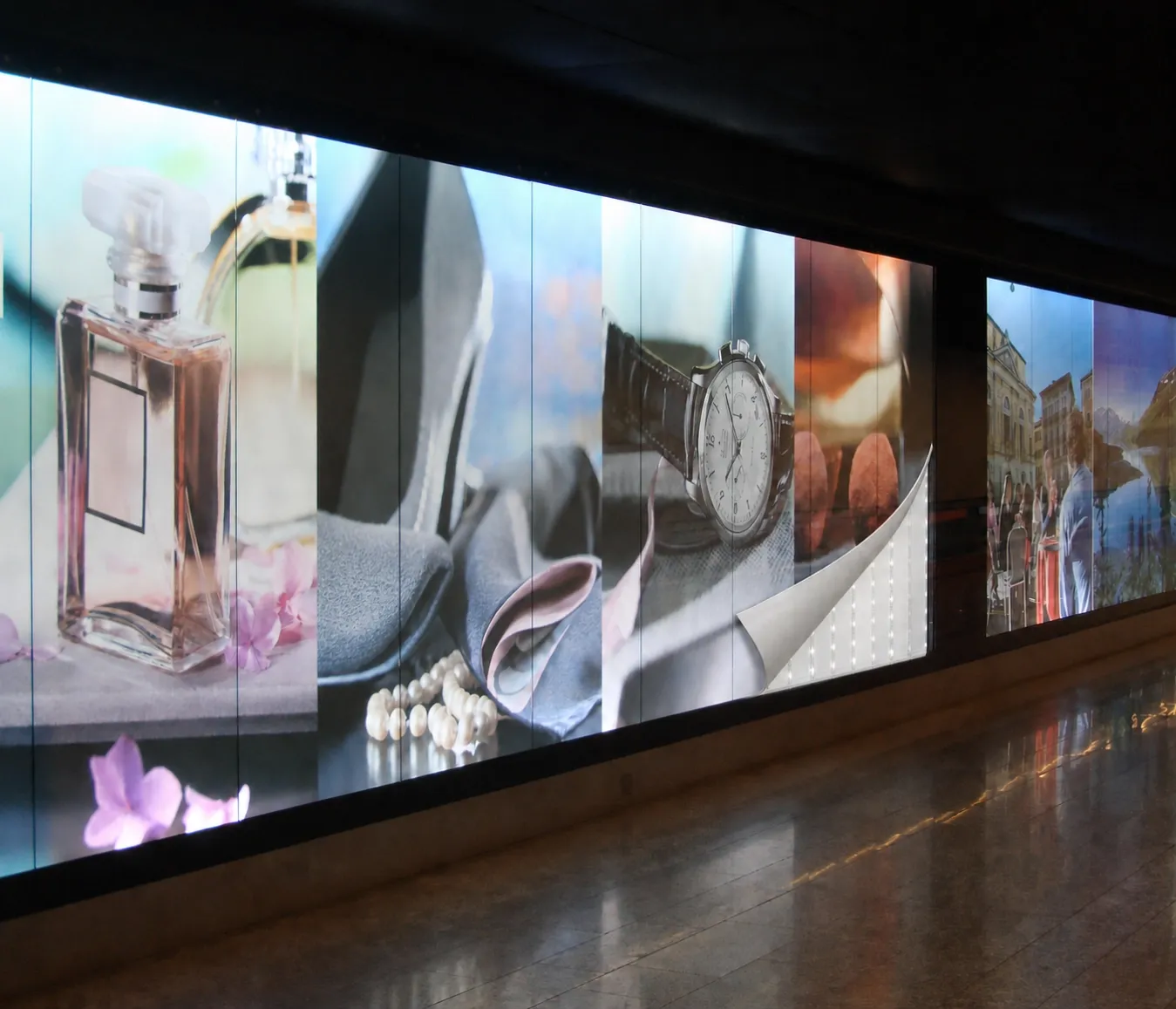
standard rectangular advertising light box with LED Lens Rigid Bars
Irregular or Curved Light Boxes
Curved, circular, and irregular light boxes require a source that can follow the structure. Wide-angle LED block lights can be positioned around the curve and adjusted locally to improve uniformity and reduce dark areas. A compatible 12 V or 24 V constant-voltage driver, 6,000 K color temperature, and CRI above 90 provide a useful starting specification for many projects.
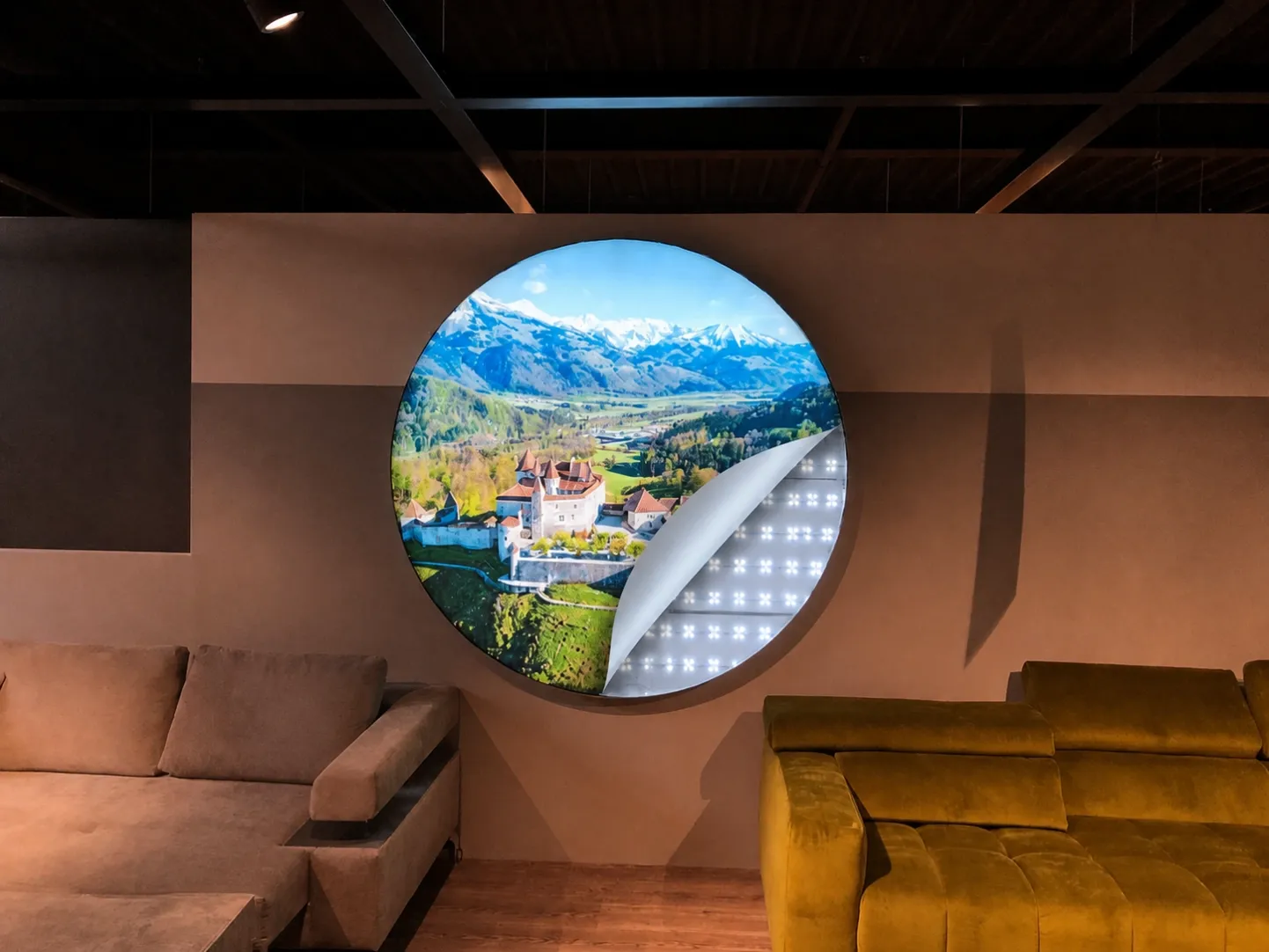
Ultra-Thin Light Boxes
Ultra-thin light boxes are usually less than 2 cm deep and are often used for interior walls, retail displays, and wayfinding signs. A side-lit LED strip combined with a light guide panel is generally the preferred solution because the guide panel distributes light across the shallow display.
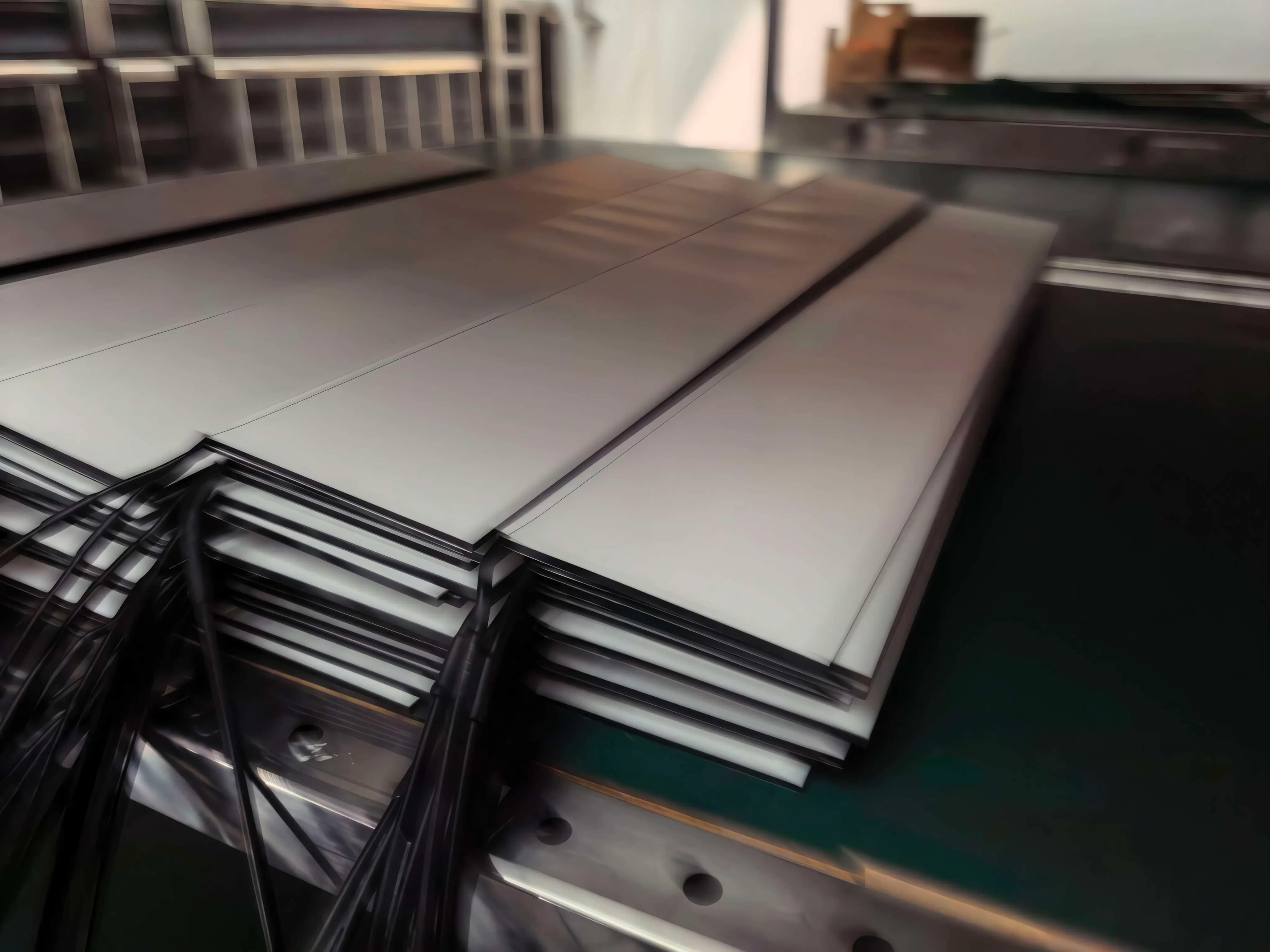
For another application-focused overview, see the Complete Guide for Selecting a Soft-Film Ceiling Light Source.
Common Problems and What to Check
Symptom | Common cause | What to check |
|---|---|---|
Visible hot spots or bright lines | Spacing is too wide, the enclosure is too shallow, the beam is too narrow, or the face material is too transparent | Test with the real face material and adjust the lens, spacing, depth, or diffusion layer |
Dark edges | The first LED row is too far from the edge, the frame blocks light, or edge reflection is insufficient | Check edge offset, frame construction, and reflective surfaces |
The far end is dimmer | Voltage drop, an excessively long series run, or undersized wire | Measure loaded voltage, increase conductor size, or add power-injection points |
Uneven areas in the graphic | Uneven ink transmission, poor source layout, or contamination on an optical surface | Test with the production graphic, adjust zones, and clean the enclosure |
Inconsistent color | Mixed LED bins or batches, temperature differences, or unbalanced control channels | Check SDCM, batch labels, thermal conditions, and controller calibration |
Premature failure | Excessive heat, water ingress, overload, poor connections, or inaccessible drivers | Inspect temperature, sealing details, load, connections, and service access |
Flicker during dimming | An incompatible driver/controller combination or poor low-load behavior | Test the complete control chain over the full dimming range |
A Practical Selection Checklist
- Define the application: indoor or outdoor, enclosure depth, size, shape, and service access.
- Set a brightness target: match the target to the ambient environment and viewing distance.
- Choose the source type: select LED lens bars, block lights, or flexible strips according to depth, shape, and uniformity requirements.
- Estimate quantity and spacing: use the project data for an initial layout, then verify it with a real sample.
- Confirm protection, certification, and warranty: make sure the light source and driver suit the installation environment and local requirements.
- Evaluate the supplier: review samples, relevant project examples, replacement options, and warranty terms.
Conclusion
Choosing the right advertising light box source requires more than comparing wattage or LED count. Depth, beam angle, spacing, target brightness, face-material transmission, color quality, efficacy, thermal management, IP protection, and maintenance access all affect the final result.
Start by defining the enclosure and visual target, choose the most suitable source type, create an initial layout, and then verify the design with the actual graphic material. A properly tested solution can improve uniformity, reduce maintenance, and lower long-term operating cost.
If you need a project-specific selection checklist, Youngopto can review your drawings and help prepare a preliminary module layout and brightness proposal before final validation.