Aug 6, 2026
Do More LEDs Per Meter Mean a Brighter Led Strip?
What is the difference between 60 LEDs/m and 120 LEDs/m - and how to detect the difference before purchasing.
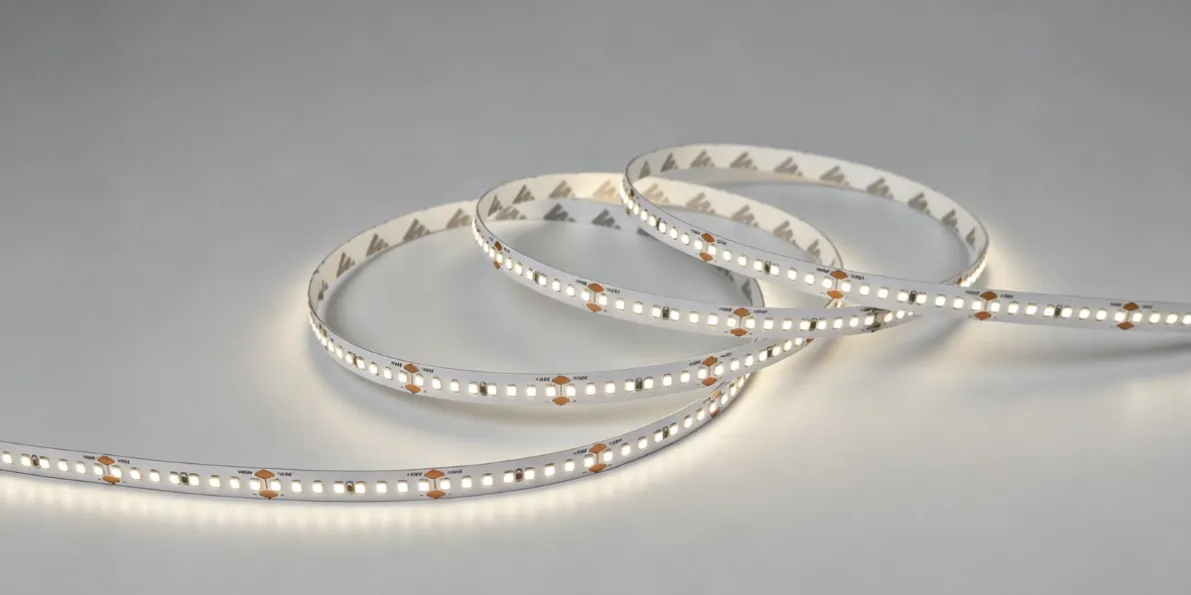
In the parameter table of LED light strips, do you often see parameters marked with 60 lights/meter, 120 lights/meter, and 240 lights/meter? We usually think that the more light beads there are, the higher the light efficiency. However, when we compare two rolls of light strips with different numbers of light beads, we may find that the roll with more light beads per meter is not as bright as the one with fewer light beads.
This isn’t an isolated case. In the world of LED strip lighting, "more LEDs = more brightness" is probably the most widespread myth. The relationship between LED density and actual brightness is far more nuanced than the numbers suggest. Let’s break it down clearly.
Density Determines Uniformity, Not Brightness
Here’s the bottom line: LED density (the number of chips per meter) primarily affects light uniformity, not overall brightness.
Imagine two strips with the same total wattage per meter: one has 60 LEDs evenly spaced, the other packs 120 LEDs into the same length. Each LED on the denser strip gets only half the power. If both use the same chip type with identical luminous efficacy, each chip puts out half the light—but there are twice as many. Total luminous flux ends up virtually the same.
Luminous Efficacy – The Overlooked Brightness Driver
The real determinant of brightness is luminous efficacy, measured in lumens per watt (lm/W). This tells you how many lumens of light each watt of electricity produces. Higher efficacy = more brightness at the same power consumption.
Take the common 2835 LED chip, typically rated at 0.2W per piece. Commercial efficacy can range from a mediocre 70 lm/W all the way up to 120 lm/W. Let’s do the math:
- Low efficacy (80 lm/W): 0.2W × 80 = 16 lumens per LED
- High efficacy (110 lm/W): 0.2W × 110 = 22 lumens per LED
That’s nearly a 40% difference in single-chip output. For a 60-LED/m strip at 12W total, the low-efficacy version puts out about 960 lumens, while the high-efficacy one delivers 1,320 lumens—a very visible gap.
A Side-by-Side Comparison That Busts the Myth
Now combine both points in a real-world scenario:
Strip | Density | Chip | Efficacy | Single-chip power | Total power/m | Total lumens |
A | 60 LEDs/m | 2835 | 110 lm/W | 0.2W | 12W | ~1,320 lm |
B | 120 LEDs/m | 2835 | 70 lm/W | 0.1W | 12W | ~840 lm |
Same wattage, Strip B has twice the LED count—but Strip A is nearly 57% brighter. The only advantage of Strip B is smoother light distribution with fewer visible hot spots, making it suitable for display cases or slim light boxes where uniformity is critical. But if your priority is bright general illumination, Strip A is the clear winner.
So, those "240 LEDs/m ultra-dense" listings that never mention efficacy? They’re likely using density digits to distract from poor performance. Buying a strip without checking efficacy is like buying a car by counting exhaust pipes instead of checking engine horsepower—you’re looking in the wrong place.
How to Choose Density Based on Your Needs
Once you understand that density and efficacy govern different things, selecting the right density becomes straightforward—it depends on how much uniformity your application demands:
- 30 LEDs/m: Wide spacing, visible hotspots. Best for decorative outlines, holiday accents, or any "just need some light" spot like toe-kick lighting under kitchen cabinets or wine cellar backlighting.
- 60 LEDs/m: The sweet spot for cost-performance. Good uniformity at a reasonable price. Perfect for living room cove ceilings, bedroom accent walls, and general ambient lighting—pair with high-efficacy chips for solid brightness.
- 120 LEDs/m: Tightly packed, nearly seamless even when viewed up close. Ideal for task lighting under kitchen upper cabinets, above desk workspaces, or anywhere you want a clean, continuous surface-light effect, especially behind thin diffusers.
- 240 LEDs/m: Extreme uniformity—the strip looks like a solid continuous light bar. Used primarily in high-end display cases, commercial light boxes, and professional settings with zero tolerance for hotspots. Not typically needed for home use; power is spread so thinly across each chip that per-LED output is weak, so you’d need very high efficacy to make it worthwhile.
Buying Guide: Check Efficacy First, Then Density
Here’s your step-by-step decision process:
Step 1 – Look at luminous efficacy. All else being equal, prioritize products with efficacy ≥ 100 lm/W. Not all sellers list this, so if it’s missing, ask for the LED flux binning spec sheet. If they can’t provide it, chances are the efficacy is mediocre.
Step 2 – Choose density by application. Decorative/ambient → 30–60 LEDs/m; primary task lighting → 120 LEDs/m; professional display → 240 LEDs/m. Don’t pay extra for "higher numbers" you don’t actually need.
Step 3 – Check chip brand and PCB quality. The chip determines efficacy ceiling and long-term stability. Reputable brands like Epistar, San'an, and Cree offer better performance and reliability. PCB copper thickness affects heat dissipation and current stability—1 oz copper is better than 0.5 oz, and double-layer boards outperform single-layer. These don’t directly show up in initial brightness, but they matter for preventing gradual dimming over time.
Final Takeaway
LED density controls uniformity.
Luminous efficacy controls brightness.
Evaluate them independently: pick efficacy for how bright you need it, then pick density for how smooth you need it. That’s the smart way to buy LED strips.