Oct 19, 2026
How to Prevent Voltage Drop and Uneven Brightness in Long LED Strip Runs
Learn how to prevent voltage drop and uneven brightness in long LED strip runs by choosing the right voltage, cable size, wiring and power-feed arrangement.
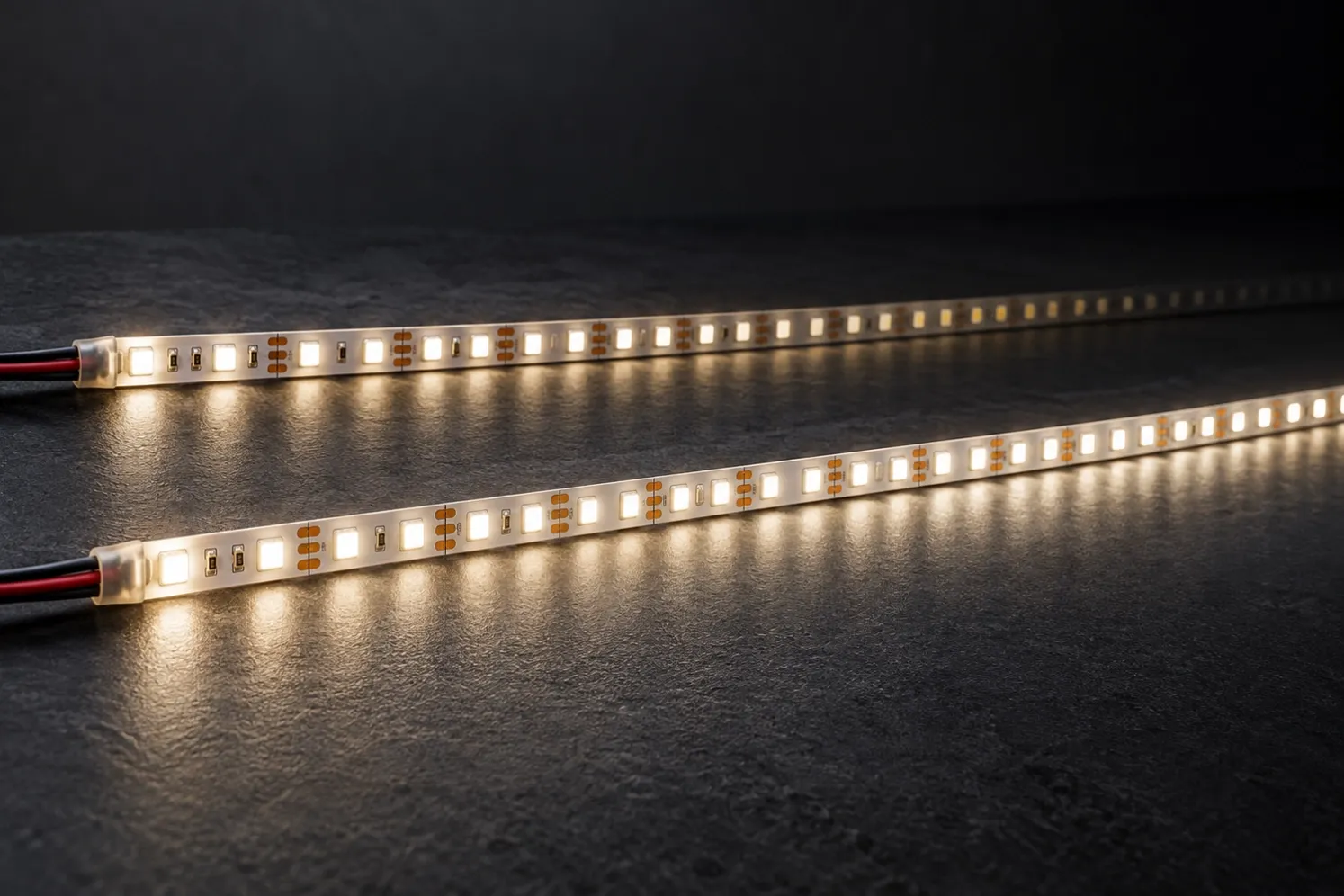
Have you ever installed a 20-30m run of LED strip in a lighting cove, closed the ceiling, and switched it on only to find that the end nearest the power supply is bright while the rest becomes progressively dimmer? Customers notice the uneven brightness immediately, but installers may struggle to correct it. A higher-wattage power supply may make little difference, and adding power injection points is difficult if the original installation did not allow for extra cabling or access openings. The ceiling may then have to be reopened and rewired, turning a day of commissioning into several days of rework.
The strip itself is not always the problem. The cause often lies in the power distribution system as a whole. Strip length, operating voltage, power per metre, cable size, connection quality and feed locations all affect the voltage available at the far end. This guide explains why voltage drop occurs, how to choose between 12V and 24V, and when to use a single-end feed, dual-end feed, centre feed or multiple power injection points.
Why Voltage Drop Makes the Far End Dimmer
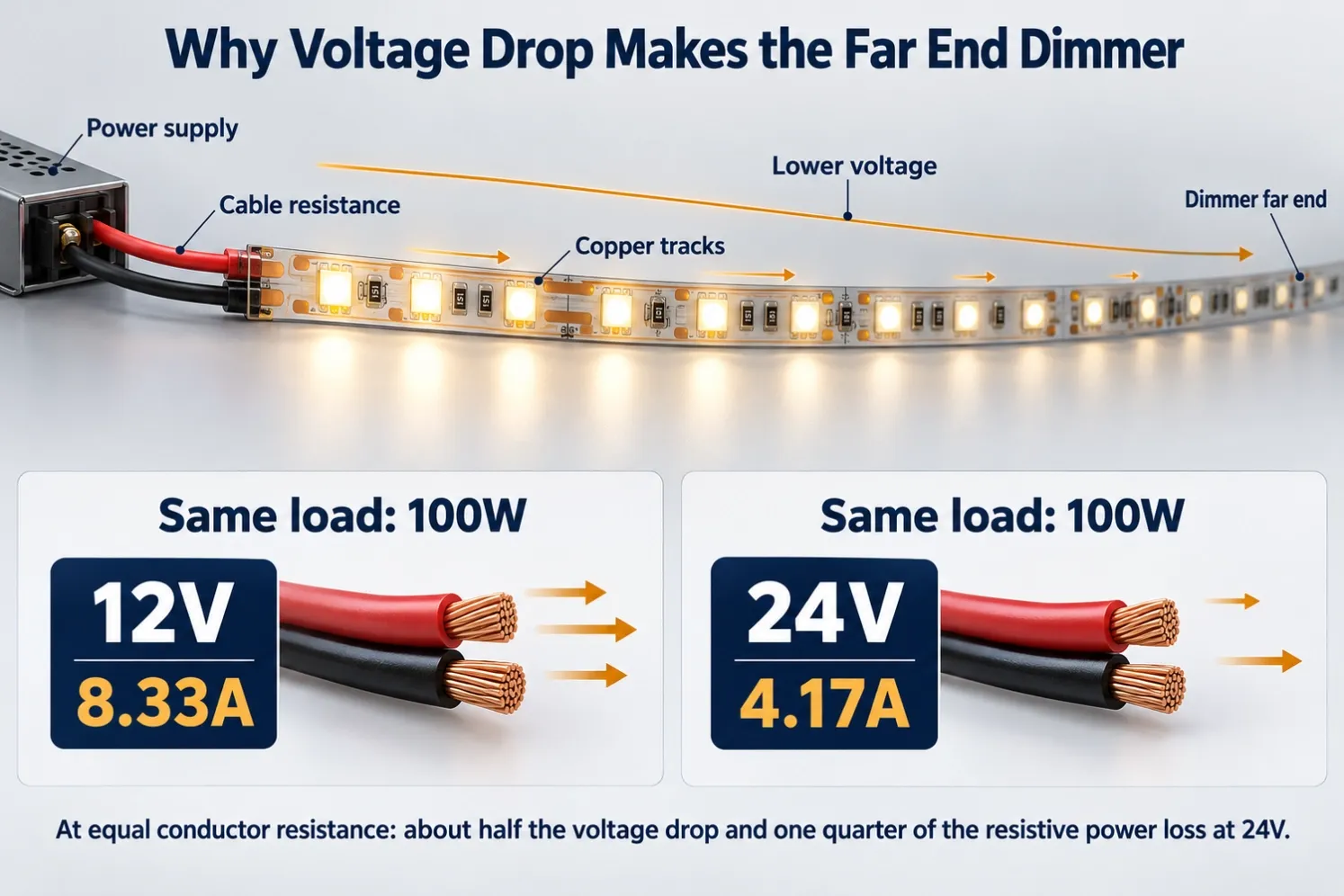
An LED strip consists of LED packages, resistors or constant-current components, a flexible printed circuit board and copper tracks. Current flows from the power supply through the cables and along the strip. The longer the path, the greater the total resistance of the conductors and connections, so the voltage falls along the run. If the voltage available at the far end is too low, light output decreases. Multi-channel RGB, RGBW and RGB+CCT strips may also show colour shifts because their channels do not respond identically to voltage changes.
For example, a 100W load draws approximately 8.33A at 12V but only 4.17A at 24V. With the same conductor resistance, the voltage drop at 24V is approximately half, while resistive power loss falls to about one quarter. For this reason, 24V or higher-voltage options are usually considered first for long runs.
Choosing Between Four Power Feed Arrangements
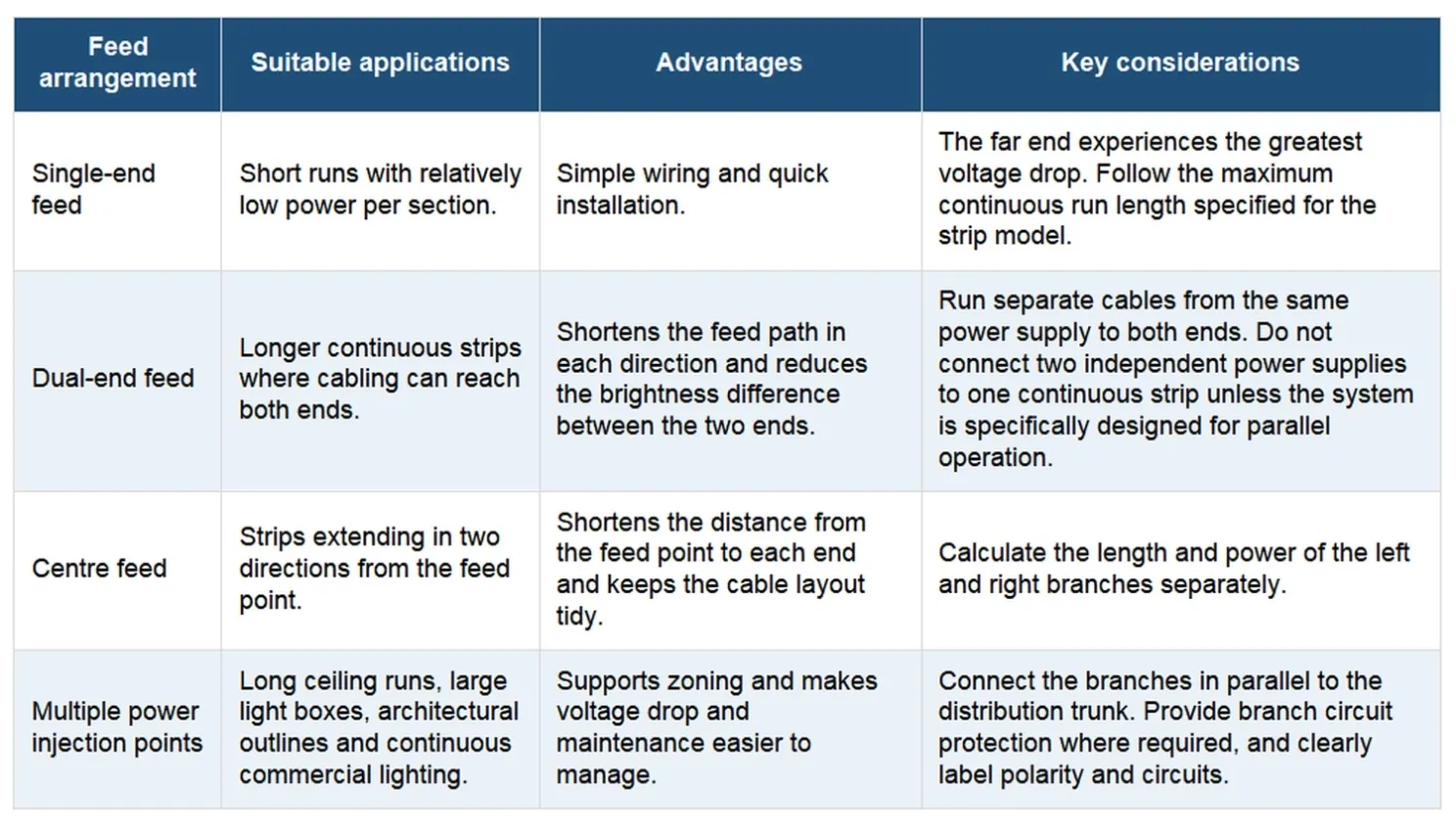
If the installation exceeds the maximum continuous run length specified for the strip, connect each section as an independent parallel branch to the power supply or distribution trunk rather than daisy-chaining several reels end to end. Dividing the installation into branches simplifies current calculations and helps isolate faults.
Choosing Between 12V and 24V
12V LED Strips
12V LED strips are better suited to short runs, small light boxes, illuminated letters and projects that require short cutting increments. A wide range of models is available, offering flexibility in cutting and installation.
24V LED Strips
24V LED strips are better suited to long cove-lighting runs, commercial displays, light boxes and linear lighting installations. For the same power, they draw less current than 12V strips, which generally makes voltage drop easier to manage over longer distances.
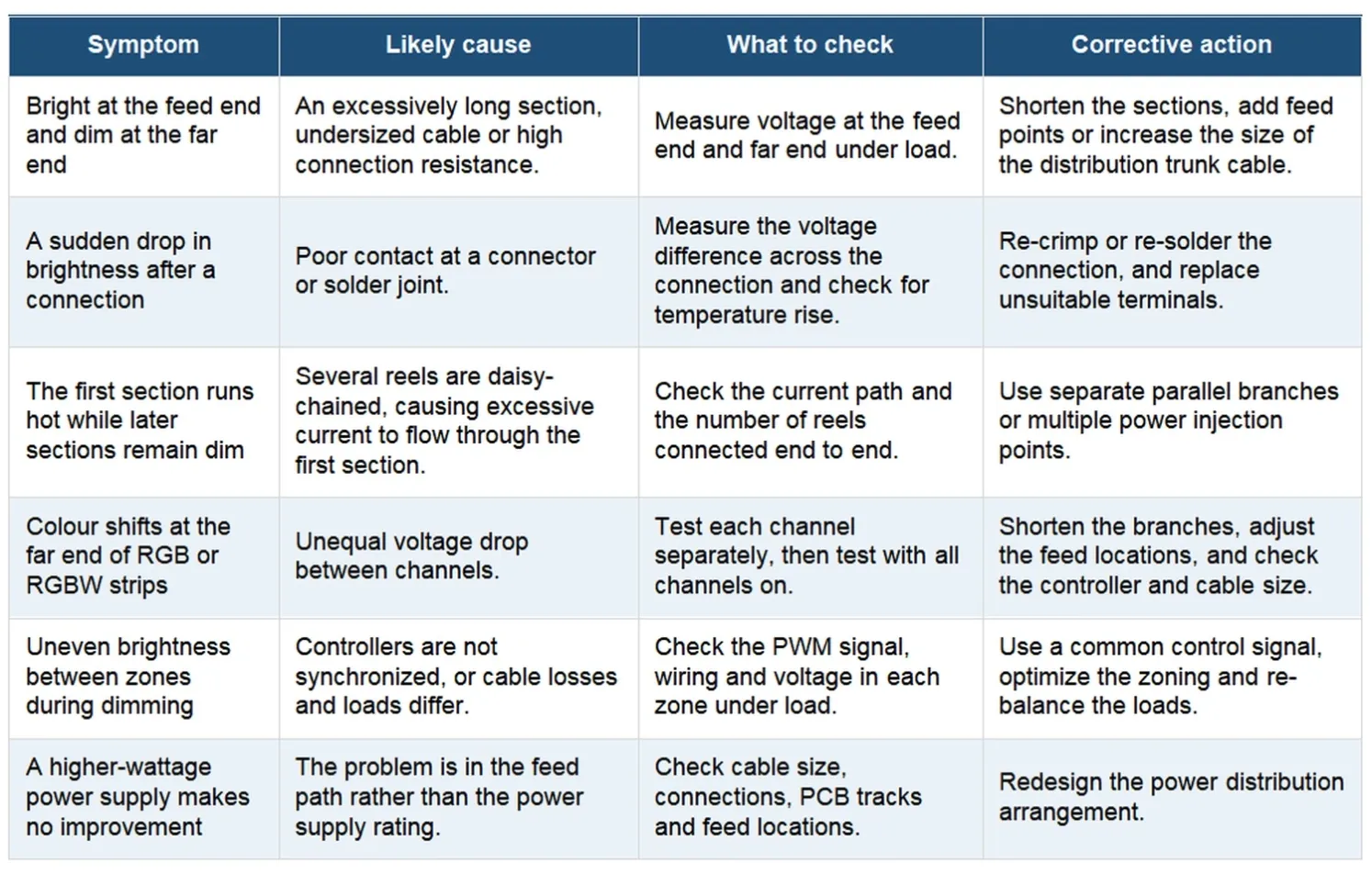
Common Faults and Troubleshooting
Frequently Asked Questions
Does a Higher-Rated Power Supply Reduce Voltage Drop
No. Provided that the power supply is not overloaded, increasing its rated wattage will not usually make a significant difference to voltage drop in the cables, connections or copper tracks of the strip. Check feed distance, cable size, connection quality and power injection points first.
Can 24V LED Strips Eliminate Voltage Drop
No. A 24V system draws less current at the same power, making voltage drop easier to manage. However, the far end can still become dim if a section is too long, power per metre is high, cables are undersized or connections are poor.
Can a Dual-End Feed Extend a Run Indefinitely
No. Feeding both ends only shortens the effective feed path. The strip's circuit design, power per metre, cables and connections still impose limits. If the manufacturer's recommended continuous run length is exceeded, use parallel sections or additional feed points.
Can Two Power Supplies Feed Opposite Ends of the Same Strip
Ordinary independent power supplies should not be connected in parallel to the same continuous strip unless the power supply manufacturer explicitly permits parallel operation and the system has been specifically designed for it. The usual dual-end arrangement uses separate cables from the same supply to both ends, or divides the strip into electrically isolated branches.
Why Do RGB Strips Show Colour Shifts as Well as Dimming
The red, green and blue channels have different electrical characteristics, and the load on each channel can vary. Voltage drop may therefore reduce their outputs by different amounts. During testing, switch on each colour channel separately, then test all channels at full output and in mixed-colour states.