Sep 14, 2026
COB vs SMD LED Strips: How to Choose the Right Option
Compare COB and SMD LED strips by light continuity, efficacy, color consistency, controls, installation, voltage drop, and application to choose the right solution.
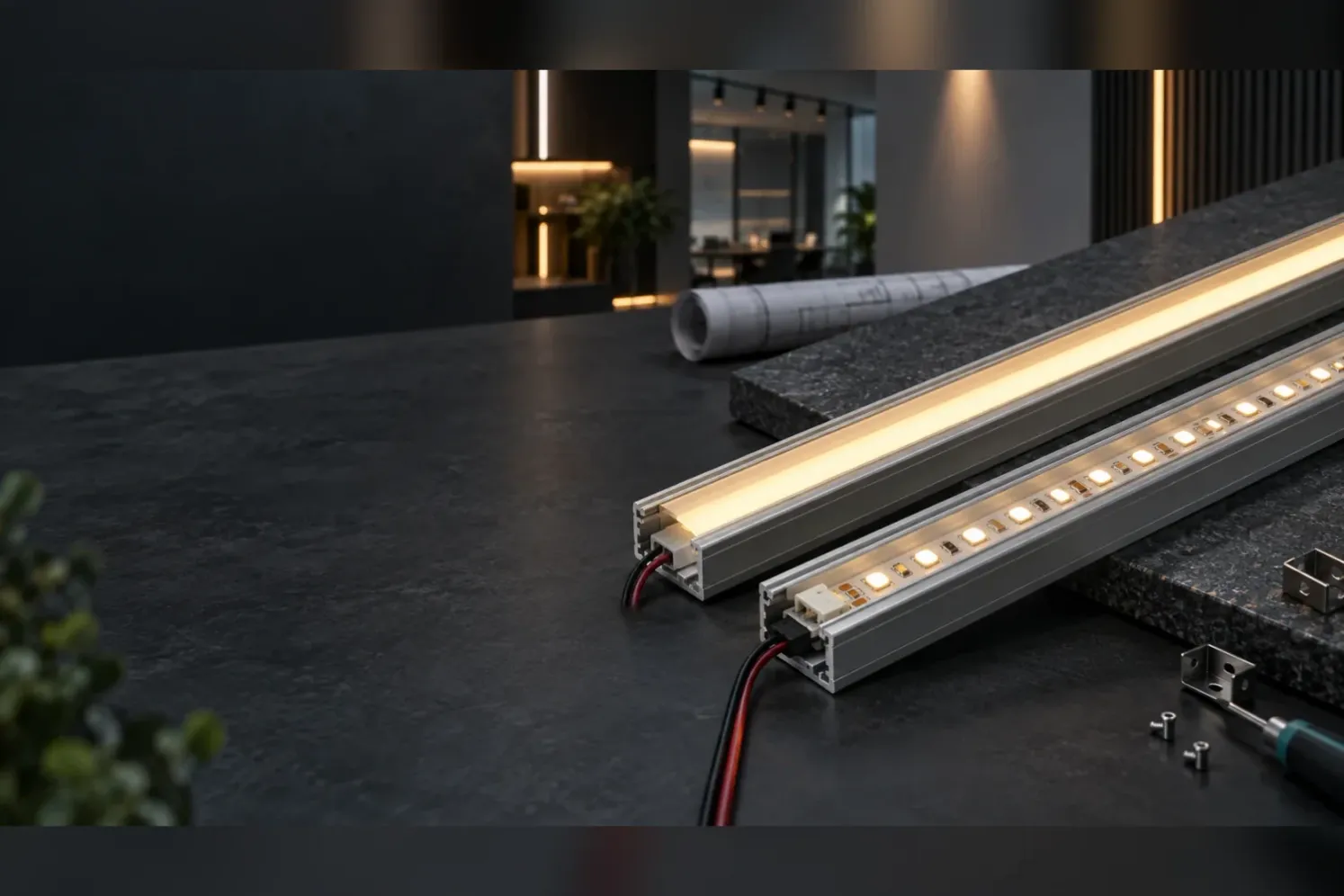
Whether used in residential lighting, commercial displays, or architectural projects, LED strips do more than provide supplemental brightness. They also define spatial outlines, add ambient light, and shape the overall atmosphere. Choosing the right strip directly affects light uniformity, spatial depth, installation quality, and long-term maintenance costs. This guide compares SMD and COB LED strips across lighting performance, product characteristics, installation conditions, and common applications to help you select the more suitable solution for your project.
Make an Initial Choice in 30 Seconds
Project Conditions | Test First | Confirm Before Final Selection |
Shallow profile
Viewed at close range
No visible light points desired | COB LED strip | Profile depth
Diffuser
Viewing distance
Temperature rise |
Hidden light source
Brightness, efficacy, or cost matters more | SMD LED strip | Lumens per meter
Efficacy
Wattage
Total installed cost |
RGB, RGBW, or dynamic pixel control required | SMD LED strip | Control protocol
Number of channels
Pixel pitch
Voltage drop |
Very high color-consistency requirements | SMD LED strip | SDCM
Binning range
Batch management
Approved sample |
Long single runs or few power-feed points | SMD LED strip | Permissible run length
PCB
Wire gauge
Power-feed method
Brightness from start to end |
Key decision: COB and SMD are two packaging and structural approaches, not quality grades. What a project actually needs to compare is final lighting performance, installation difficulty, total system cost, and whether the solution can reliably meet the design requirements.
What Are COB and SMD LED Strips?
COB LED Strips
COB stands for Chip on Board. A common construction places many small LED chips densely on a flexible printed circuit board, then covers them with a continuous phosphor or encapsulation layer. The short distance between chips and the continuous emitting surface make it easier to create a uniform line of light in shallow profiles or close-viewing applications.
SMD LED Strips
SMD stands for Surface-Mounted Device. The LED chips are first packaged as individual LEDs and then mounted on the circuit board. Each packaged LED acts as a separate light-emitting unit. SMD LED strips have a mature product ecosystem and typically offer more configurations, including single color, tunable white, RGB, RGBW, RGB plus CCT, and pixel control.
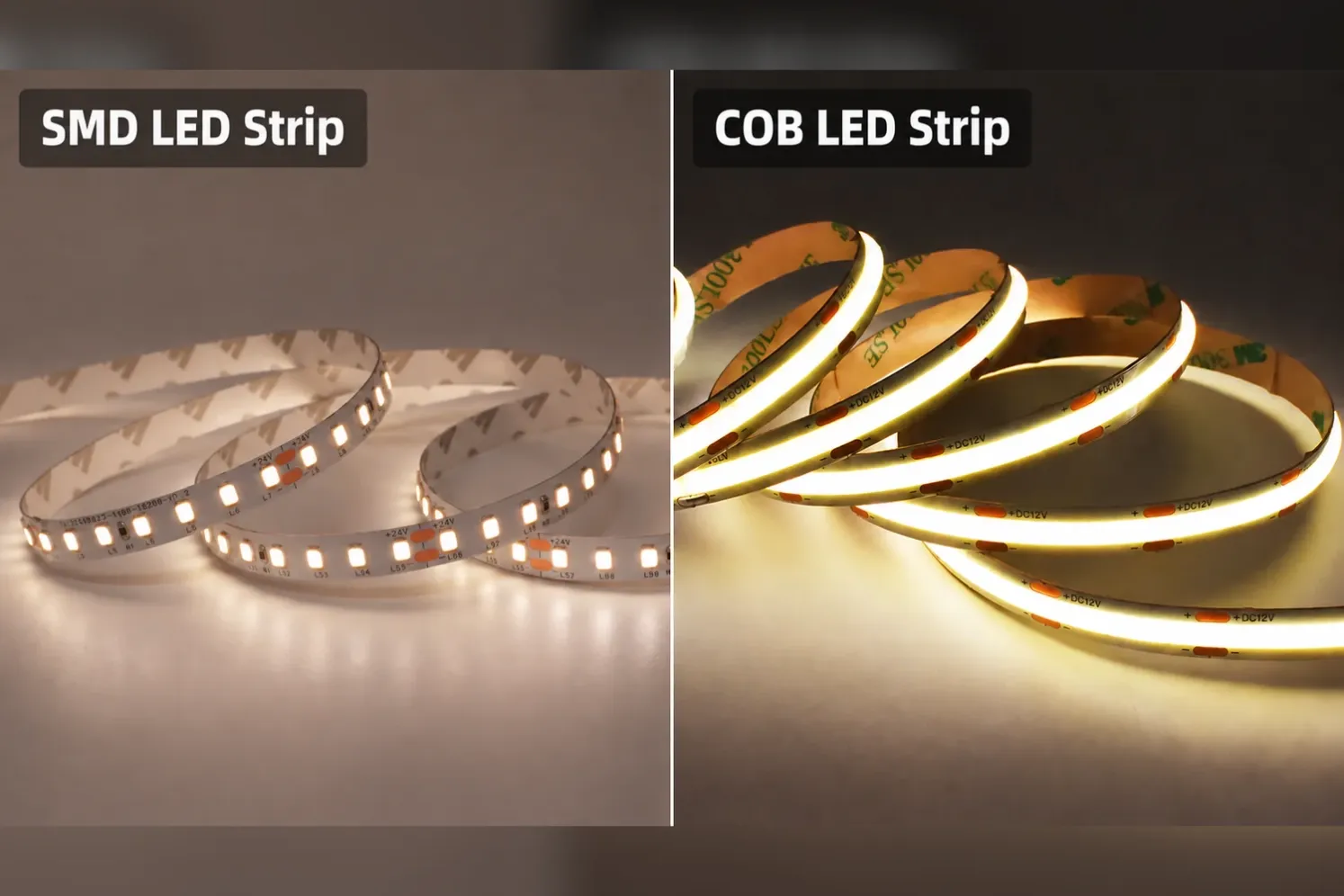
The left side shows SMD LEDs; the right side shows COB structure.
Five Differences That Matter to a Project
Continuity and Softness
The most visible advantage of COB is reduced pixelation. Display cases, cabinets, shallow aluminum channels, surface-mounted linear lights, and visible outline lighting are all viewed at close range, making the individual points of a conventional SMD strip easier to see. COB uses more densely arranged chips and usually forms a more continuous line of light after the diffuser is installed.
Brightness and Efficacy
SMD LED strips can provide higher brightness. SMD products can use larger chips, their packaging materials can produce less optical loss than COB, and different series-parallel LED configurations can achieve higher efficacy.
Color Consistency
SMD LEDs can be binned by chromaticity coordinates before mounting, so suppliers can usually manage color differences more easily by specifying LED bins. SMD is the preferred first option for washing white walls, combining multiple LED-strip runs in the same space, or applications that are sensitive to a brand's standard color.
Stability and Installation Conditions
SMD uses individual packages, while COB covers its chips with a continuous encapsulation layer. COB LED strips are more susceptible to damage from sharp-angle bending, repeated twisting, or stress on solder joints. Whether a product can withstand site installation depends on the PCB structure, encapsulation, permitted bending direction, operating temperature, and installation method.
Voltage Drop and Long-Distance Powering
Whether a 15- or 20-meter run can maintain consistent brightness from start to end depends on the voltage, wattage per meter, PCB copper, wire, connectors, and power-feed method. SMD LED strips can achieve 20-meter runs without voltage drop, while COB LED strips currently support up to 10 meters without voltage drop.
Comparison | COB LED Strips | SMD LED Strips | Project Decision |
Light continuity | Densely arranged chips make individual light points less apparent | LED spacing may remain visible through the diffuser | Test COB first when the light source is visible or the profile is very shallow |
Brightness and efficacy | Products vary widely; performance cannot be judged by the COB name alone | More options are available, from decorative output to high-output products | Compare lumens per meter and lumens per watt under equivalent conditions |
Color consistency | Finished-product and batch control are possible, but the actual specification must be checked | Packaged LEDs can be binned before mounting, and more selections are typically available | Request the SDCM and binning range, and lock in an approved sample |
Color and control | Single-color, CCT, RGB, and RGBW options are available | Multichannel and pixel-control options are typically more extensive | Define the control method first, then match the LED strip |
Installation and repair | The continuous encapsulation layer is not suitable for LED-level field repair | Failure points are easier to identify, although strips are still commonly replaced by segment | Verify cut length, bending direction, and heat dissipation |
How to Choose for Common Applications
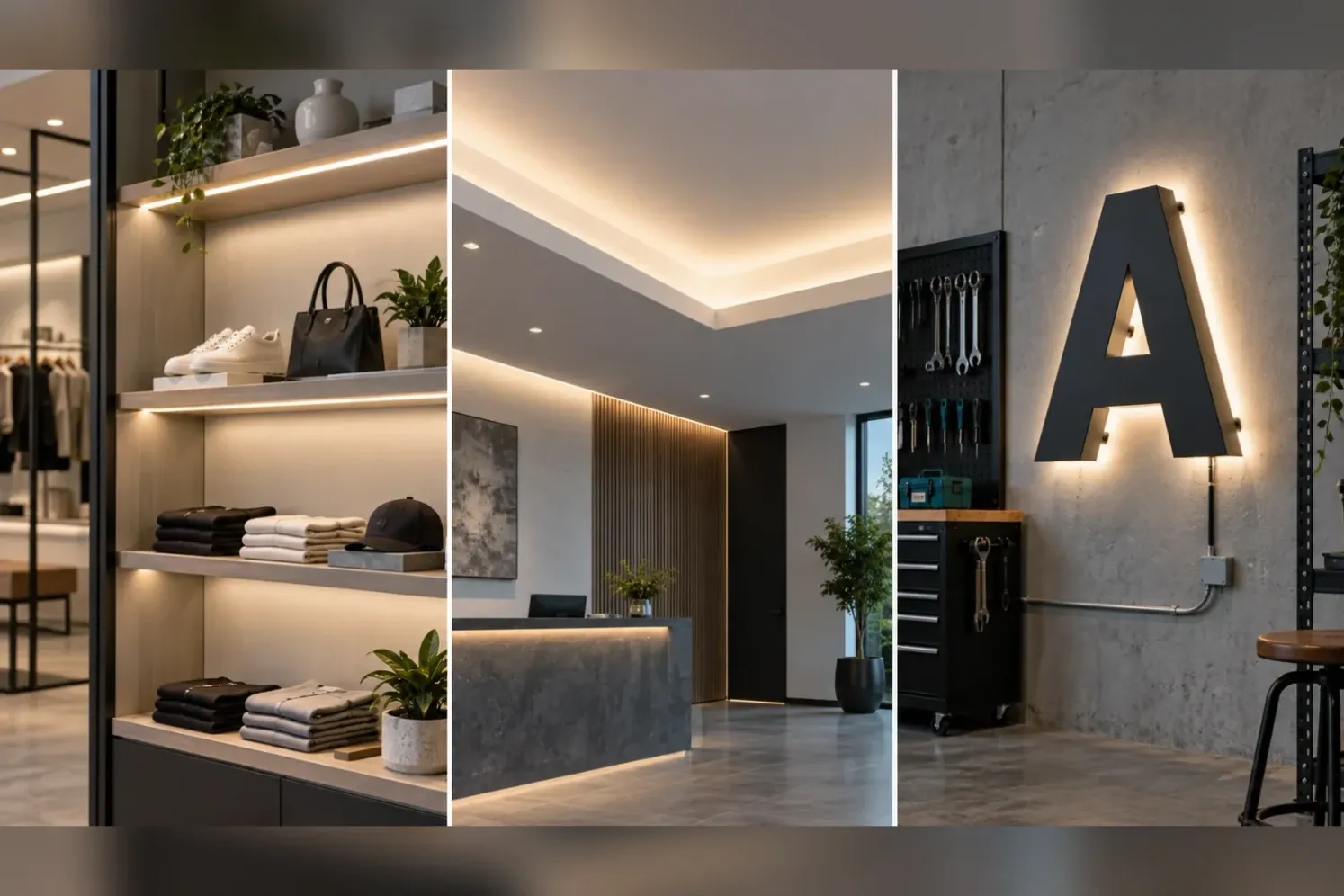
From left to right: close-view cabinet lighting, concealed cove lighting, and halo-lit channel letters.
Cabinets and display cases | COB or high-density SMD | Close viewing makes light continuity and color rendering more important | Glare control
Profile temperature rise
CCT
CRI
SDCM |
Cove lighting and curtain pockets | SMD LED strips | The light source is hidden, so output and cost can take priority | Throw distance
Lumens per meter
Efficacy
Voltage drop |
Shallow-profile linear lights | COB first | Limited light-mixing distance makes light points easier to see | Diffuser performance
Cut length
Wattage
Heat dissipation through the aluminum channel |
Channel letters and outlines | Narrow-PCB SMD, COB, or neon flex | The light source must follow strokes, curves, and visible lines of light | Narrowest stroke
Bending direction
Letter depth
Wiring space |
Large light boxes and fabric ceilings | LED block lights, modules, or rigid LED bars | Large-area projects place greater emphasis on coverage and installation quantity | Beam angle
Layout spacing
Power-supply zoning
Total cost |
Parameters to Check Before Purchasing
- Luminous flux per meter and wattage per meter: Used to estimate actual brightness, power-supply capacity, and temperature rise.
- Luminous efficacy: Lumens per watt indicate how much light is produced at the same power.
- CCT, CRI, and SDCM: Used to evaluate light color, color rendering, and color consistency.
- Voltage, permissible single-run length, and power-feed method: Used to assess voltage drop and wiring.
- PCB width, cut length, and bending direction: Used to determine whether the strip fits the intended structure.
- IP rating, cut ends, connectors, cable exits, and power-supply protection: Used to assess the water- and dust-resistance of the complete system.
- Operating temperature and heat-dissipation requirements: Used to determine whether the aluminum profile and mounting surface are suitable.
Conclusion
When the light source is directly visible, address continuity and glare first. When the light source is hidden, compare the brightness reaching the illuminated surface and the system's efficacy first. Evaluate color consistency through SDCM and batch control, long runs through voltage drop and power-feed design, and installation reliability through PCB construction, heat dissipation, and bending limits. Once these questions are considered separately, choosing between COB and SMD becomes much more straightforward.