Jul 2, 2026
Why does the same 4000K look different
The issue lies in not requiring color difference tolerance when selecting led lamps. When choosing led lamps, it is important to ensure a uniform color temperature and specify color difference tolera

Can you believe it? This is the light color produced by the same 4000K
Why do different brands of led lamps with the same color temperature of 4000K appear so different in color? After installing led lamps with the same color temperature of 4000K, it is often found that some lamps appear yellowish while others appear whitish, especially when different brands of led lamp are installed in the same space. What is the problem? The issue lies in not requiring color difference tolerance when selecting led lamps. When choosing led lamps, it is important to ensure a uniform color temperature and specify color difference tolerance. The same batch of lighting fixtures should use light beads from the same brand, with color difference tolerance less than or equal to 3 steps. As long as the color difference tolerance is well controlled, it is almost impossible for the naked eye to see the difference. Conversely, the greater the color difference tolerance, the more obvious the color temperature difference.
Three core factors lead to visual differences:
1、The pitfall of MacAdam Ellipse
The color temperature coordinate is not a "point" on the CIE chromaticity diagram, but an olive-shaped range (as shown in the figure). Even if two LED beads with the same color temperature of 4000K fall at the two ends of the ellipse, the human eye can detect a significant color difference. The mixed use of LED beads with "Step 3" (3rd-order tolerance) in industry standards may already cause visible differences.
2、Invisible interference of color rendering index (CRI)
LED beads with a CRI (Color Rendering Index) of >90 can more accurately reproduce the colors of objects, but the differences in R9 (red saturation) and R12 (blue saturation) can alter the "character" of white light. When two strings of 4000K LED beads have different CRI distributions, one string may make wood grain appear warmer, while the other makes metal appear cold and stern.
3、The scam of "color memory" in human eyes
The human brain automatically calibrates color perception (color constancy) based on environmental light sources. When viewed alone, the A light string appears pure white, but when compared to the B light string, the slight color difference is sharply magnified - this is why when we look at a single light, we feel that the light color is similar, but when many lights are installed together, the light color appears inconsistent.
Our solution:
1、Bin grading strict selection
Try to use beads from the same brand with a color tolerance of less than 3 steps for different types of lighting fixtures, ensuring that the color coordinate fluctuation of the entire light string is ≤ 3 SDCM
2、 Spectral intelligent matching
By strictly controlling the incoming materials, the uniformity of R9/R12 values in the 4000K range is ensured, so that the color "memory" of different batches remains consistent
3、 Consider in advance factors that may cause inconsistent color temperature
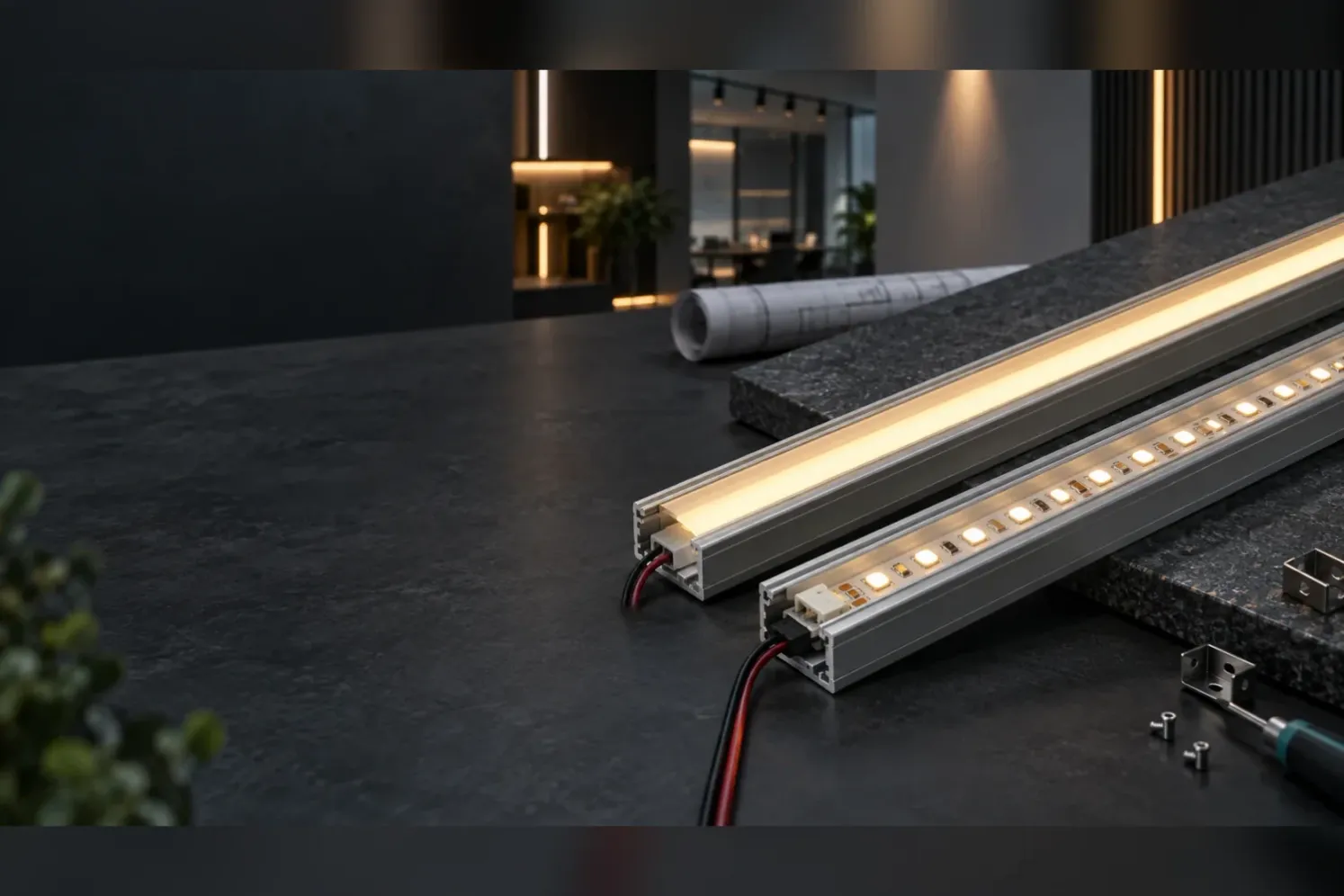
Provide consideration for the installation location of lighting fixtures. If the light strip is installed in the light groove, it is necessary to consider whether the light output of the light strip will be affected by the decoration materials, and to understand in advance the potential visual deviation risks after installation
Controlling color difference is not a technical issue, but a reverence for every link in the supply chain. Have you ever found significant color difference after installing a project, and how did you solve this problem? Welcome to share your experience in dealing with it.